MITHRIDATES
It seems like Pakistan is finally getting it ("it" being my — America's, the Western World's — way of thinking). From the low point of moving troops towards the India border after the Mumbai attacks and a peace deal with the Taliban earlier in the year, Pakistan has come a long way and is now apparently taking the fight to the Taliban. Apparently they're even making some gains.
More...
The US criticized the peace deal from the beginning, but diplomacy consists of getting other countries to do what you want — it's not, as Vercingetorix rightly points out, just asking for it. But it's not just criticizing them, either. Finally, the Pakistani government seems to be doing something we want — cooperating in the fight against the Taliban. There's still the sensitivity of having American soldiers on their soil, but the Obama folks and the Islamic Republic folks seem to be finessing that by training counterinsurgency troops in an undisclosed third country.
There's still a long way to go, and the Pakistani government defines dysfunctional, so who knows how long they'll keep this up? Maybe it's the immediacy of the Taliban threat. Maybe it's the diplomatic genius of the new administration. Maybe it's the realization that although posturing against India wins you some domestic political support, India poses no real threat. Who knows? But it's good to have — at least for the time being — Pakistan fighting a second front against the Taliban instead of just hindering our fight on the first front.
Showing posts with label India. Show all posts
Showing posts with label India. Show all posts
Friday, May 01, 2009


Monday, January 26, 2009
India VII: Odds and End
MITHRIDATES
So I've been back in the First World for a month now, which means the statute of limitations on travel-blogging runs out at midnight. I leave you with these highlights and lowlights.
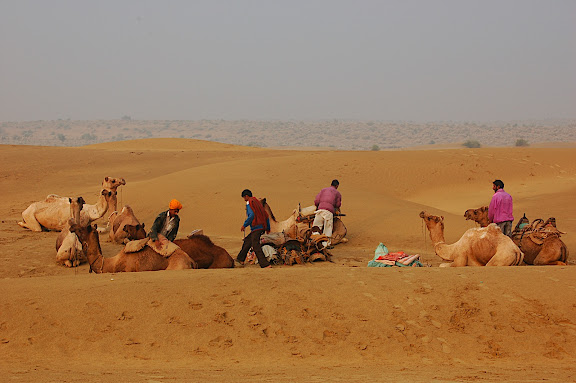
On an overnight train December 15 from Jodhpur to Jaisalmer, I shared a cabin with an air force lieutenant. He said they weren't on alert anymore (they were for two weeks after the Mumbai attacks), which meant it was safe to hop on camels and head off into the Thar desert on the Pakistani border.
 More...
We rode on camels until we were sore and camped on the dunes out of sight of any other tourists, locals, or any other life form. Do this. It's kitschy, it's touristy, but it's FUN! We cooked curried vegetables over a campfire, drank Kingfishers, watched the sunset over the dunes, and slept out on the sand. We sang "Hotel California" and "Country Road" by the campfire. Our camel-driving crew nicknamed me Michael Jackson (because of my range and skin color?).
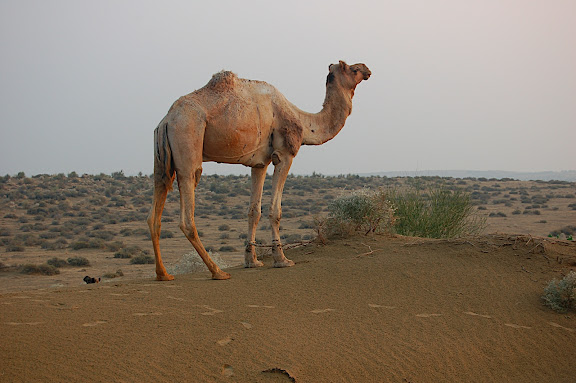
Oh, and just for the record, there are lots of filthy animals in India, but camels may be the filthiest. They swallow big chunks of shrubbery, then chew it, then swallow it again. This process gets repeated several times. Get the picture? Yum! The list of things I'd rather do than make out with my camel is very, very long.
The caste system may not be as formal as it used to be, but there's a clear distinction between upper and lower class. When I first flew into Mumbai eleven years ago, I traveled in style — first class on Air India (I don't miss my old job - hell no — but I do miss other people paying for things). I was kind of tired when the plane landed and took my time, but the flight attendants were in a panic trying to get me off the plane. You see, under no circumstances could the first-class passengers be allowed to mix with the rest, and so everyone else on the plane had to wait for me, no matter how long it took.
Things hadn't changed this time around, even though I've got one tenth the budget. I'm traveling on my own at this point and at one hotel it's just me in the dining room. Let's just say it's a bit awkward having two servants stand at attention watching me slop curry all over my face, watching so closely that they can remove it the instant I'm done. But this was less uncomfortable than the time eleven years ago when the locker room servant tried to help my boss off with his pants in the hotel gym. Really sir, let me help. True story.
But the employees don't just serve the guests. As far as I can tell they are virtual slaves to their employers, bringing them drinks, working around the clock, sleeping on fetid cots in the basement between shifts. One guy had to massage the temples of the fat shirtless hotel owner at the place I stayed in Jodhpur. Looked like an unpleasant task.
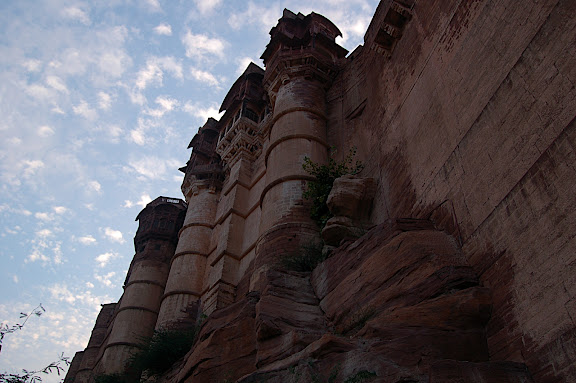
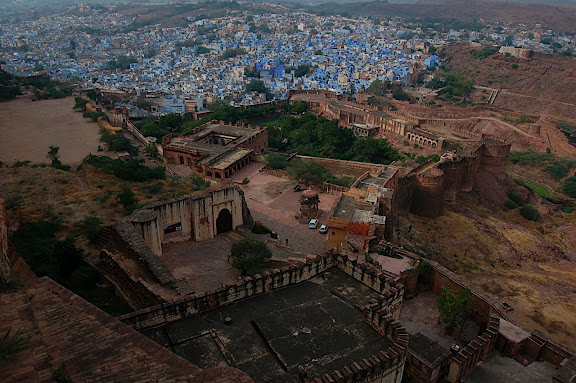
Ahmedabad, Gujarat is the worst place on Earth. There's no need to ever go there. Mt. Abu is the chillest place in Rajasthan. Go there when you need a break from the sweltering, polluted, overcrowded cities. Udaipur is mellow and the lake isn't as nice as it looks in Octopussy, but certainly a nice place to hang out. Jaisalmer is fun, Jodhpur is a polluted, overcrowded city, but the old town (right) is nice and the fort (left) makes it worth the trip. One local kid I passed strolling through the streets at night declared me the tallest man in Jodhpur.
Christmas Eve I had dinner at the Taj Palace in Mumbai. A month after the attacks the place was open for business and packed with tourists, including your fair share of Americans, Brits, and Jews (all allegedly targets in the attacks). So choke on that, you terrorist fuckwads!
There's no place like it on Earth. I'm dying to see it in ten years. Will the economy keep growing like it is? As the middle class gets bigger and richer will they feel compelled to develop some sort of welfare system for the hundreds of millions of wretched poor? Will they keep on having giant families and overtake China in population? I have no frickin' idea. But I'm sure I'll want to check back in on things again. For now, good-bye, India . . .
So I've been back in the First World for a month now, which means the statute of limitations on travel-blogging runs out at midnight. I leave you with these highlights and lowlights.
On an overnight train December 15 from Jodhpur to Jaisalmer, I shared a cabin with an air force lieutenant. He said they weren't on alert anymore (they were for two weeks after the Mumbai attacks), which meant it was safe to hop on camels and head off into the Thar desert on the Pakistani border.
 More...
We rode on camels until we were sore and camped on the dunes out of sight of any other tourists, locals, or any other life form. Do this. It's kitschy, it's touristy, but it's FUN! We cooked curried vegetables over a campfire, drank Kingfishers, watched the sunset over the dunes, and slept out on the sand. We sang "Hotel California" and "Country Road" by the campfire. Our camel-driving crew nicknamed me Michael Jackson (because of my range and skin color?).
Oh, and just for the record, there are lots of filthy animals in India, but camels may be the filthiest. They swallow big chunks of shrubbery, then chew it, then swallow it again. This process gets repeated several times. Get the picture? Yum! The list of things I'd rather do than make out with my camel is very, very long.
The caste system may not be as formal as it used to be, but there's a clear distinction between upper and lower class. When I first flew into Mumbai eleven years ago, I traveled in style — first class on Air India (I don't miss my old job - hell no — but I do miss other people paying for things). I was kind of tired when the plane landed and took my time, but the flight attendants were in a panic trying to get me off the plane. You see, under no circumstances could the first-class passengers be allowed to mix with the rest, and so everyone else on the plane had to wait for me, no matter how long it took.
Things hadn't changed this time around, even though I've got one tenth the budget. I'm traveling on my own at this point and at one hotel it's just me in the dining room. Let's just say it's a bit awkward having two servants stand at attention watching me slop curry all over my face, watching so closely that they can remove it the instant I'm done. But this was less uncomfortable than the time eleven years ago when the locker room servant tried to help my boss off with his pants in the hotel gym. Really sir, let me help. True story.
But the employees don't just serve the guests. As far as I can tell they are virtual slaves to their employers, bringing them drinks, working around the clock, sleeping on fetid cots in the basement between shifts. One guy had to massage the temples of the fat shirtless hotel owner at the place I stayed in Jodhpur. Looked like an unpleasant task.
Ahmedabad, Gujarat is the worst place on Earth. There's no need to ever go there. Mt. Abu is the chillest place in Rajasthan. Go there when you need a break from the sweltering, polluted, overcrowded cities. Udaipur is mellow and the lake isn't as nice as it looks in Octopussy, but certainly a nice place to hang out. Jaisalmer is fun, Jodhpur is a polluted, overcrowded city, but the old town (right) is nice and the fort (left) makes it worth the trip. One local kid I passed strolling through the streets at night declared me the tallest man in Jodhpur.
Christmas Eve I had dinner at the Taj Palace in Mumbai. A month after the attacks the place was open for business and packed with tourists, including your fair share of Americans, Brits, and Jews (all allegedly targets in the attacks). So choke on that, you terrorist fuckwads!
There's no place like it on Earth. I'm dying to see it in ten years. Will the economy keep growing like it is? As the middle class gets bigger and richer will they feel compelled to develop some sort of welfare system for the hundreds of millions of wretched poor? Will they keep on having giant families and overtake China in population? I have no frickin' idea. But I'm sure I'll want to check back in on things again. For now, good-bye, India . . .
Tuesday, January 20, 2009
India VI: Slumdogs
MITHRIDATES
There was nothing the most beautiful woman I've ever seen (no exaggeration) wanted to do more Saturday night than see Slumdog Millionaire with me. In case you haven't noticed — and judging by the page views you haven't — I've just recently returned from a trip to India, including a few days in Mumbai where the movie takes place. Well, I was dying to see it with her, too. It's been out for a couple of months, but the Golden Globes have rekindled interest and the theater was packed. And rightly so. It's a great movie. Go see it.
Sometimes the wretchedness depicted in a movie doesn't seem plausible. People couldn't be that poor, that miserable, that abused. The police couldn't be that corrupt and uncaring. Life couldn't be that unfair. Was this movie a fair and accurate description of real life in India? I can't say for sure. I was only there for a short while and almost certainly didn't see the worst. But based on what I did see it was certainly a plausible one.
More...
In the movie: A small boy jumps into a pile of human waste and pushes through a crowd to get his favorite movie star's autograph.
What I saw: Shit everywhere. Of every kind. Kids running through the streets barefoot, getting it all over them. People squatting on the side of the road — sorry, ain't no anti-bacterial hand soap and running hot water nearby to wash those hands — make sure you eat with your left . . . Slums so vast and crowded that there's no way any sort of proper sewage could possibly do the job. Huts in the countryside literally made of cow-shit.
OK, so I didn't see anyone actually covered head to foot in excrement, but other than that . . .
In the movie: A gangster enslaves orphans, trains them to sing, and blinds them. Why blind them? So that when they spend the rest of their childhood (who knows what happens after) singing on a corner for handouts they'll get more sympathy from passers-by, and therefore more money for their masters.
What I saw: Beggars with mutilated feet and children on the sidewalk holding deformed babies. Eleven years ago after visiting the Taj Mahal, our guide took us to a shop where you could buy jewelry boxes and stuff like that made of marble and inlaid stone reminiscent of the Taj. We got a tour of the factory where the owner pointed to a handful of boys sitting against the wall putting tiny pieces of stone decorations into the marble. He told us they'd work here like this until they were in their teens at which time their fingers would no longer be delicate enough to handle the intricate work. Child labor for sure. Forced child labor? Sure looked like it. And what happens after?
OK, so I never witnessed anything quite as horrifying as in the movie, but is it out there? People seem to think so . . .
In the movie: Slum children playing cricket (or some game with a ball and a stick) on the airport runway, dodging planes and being chased by police.
What I saw: During the descent into the domestic airport in Mumbai you fly very low over what seems like an endless stretch of tin shacks — until all of a sudden you're right over the runway. The shacks literally press right up against the airport fence.
OK, so our plane didn't actually run over any kids, but the runway was certainly the biggest playing field around.
But I'm making the movie — and the country for that matter — sound terribly depressing. Sure, it is at times, but it's got an exciting plot, with some brilliant performances from the young actors and a pretty compelling love story. This guy's in love with this girl, she clearly wants to be with him, but she's with someone else and not nearly as happy as she'd be with him. Sounds like a million other Hollywood stories, but in this one I find myself really rooting for the guy. It also helps that she's stunningly beautiful. I can't tell you here how it ends . . .
India is an amazing place and has much to offer. Its economy is growing fast and it's made remarkable progress. A century ago, historian Sir Martin Gilbert estimates that about half a million people a year died of the plague — it's certainly come a long way from that, although Usha and Zubin Ronowat might dispute how far it's really progressed. It's a dynamic place and the streets feel more alive than anywhere I've been. But still, to me, the single most defining aspects of India are the overpowering smell and the vast, crushing, unparalleled poverty that affects hundreds of millions in the city slums and countryside. You get used to the smell after a couple of days. You really do. I think your nose just gets tired. But you never quite get used to the poverty . . .
There was nothing the most beautiful woman I've ever seen (no exaggeration) wanted to do more Saturday night than see Slumdog Millionaire with me. In case you haven't noticed — and judging by the page views you haven't — I've just recently returned from a trip to India, including a few days in Mumbai where the movie takes place. Well, I was dying to see it with her, too. It's been out for a couple of months, but the Golden Globes have rekindled interest and the theater was packed. And rightly so. It's a great movie. Go see it.
Sometimes the wretchedness depicted in a movie doesn't seem plausible. People couldn't be that poor, that miserable, that abused. The police couldn't be that corrupt and uncaring. Life couldn't be that unfair. Was this movie a fair and accurate description of real life in India? I can't say for sure. I was only there for a short while and almost certainly didn't see the worst. But based on what I did see it was certainly a plausible one.
More...
In the movie: A small boy jumps into a pile of human waste and pushes through a crowd to get his favorite movie star's autograph.
What I saw: Shit everywhere. Of every kind. Kids running through the streets barefoot, getting it all over them. People squatting on the side of the road — sorry, ain't no anti-bacterial hand soap and running hot water nearby to wash those hands — make sure you eat with your left . . . Slums so vast and crowded that there's no way any sort of proper sewage could possibly do the job. Huts in the countryside literally made of cow-shit.
OK, so I didn't see anyone actually covered head to foot in excrement, but other than that . . .
In the movie: A gangster enslaves orphans, trains them to sing, and blinds them. Why blind them? So that when they spend the rest of their childhood (who knows what happens after) singing on a corner for handouts they'll get more sympathy from passers-by, and therefore more money for their masters.
What I saw: Beggars with mutilated feet and children on the sidewalk holding deformed babies. Eleven years ago after visiting the Taj Mahal, our guide took us to a shop where you could buy jewelry boxes and stuff like that made of marble and inlaid stone reminiscent of the Taj. We got a tour of the factory where the owner pointed to a handful of boys sitting against the wall putting tiny pieces of stone decorations into the marble. He told us they'd work here like this until they were in their teens at which time their fingers would no longer be delicate enough to handle the intricate work. Child labor for sure. Forced child labor? Sure looked like it. And what happens after?
OK, so I never witnessed anything quite as horrifying as in the movie, but is it out there? People seem to think so . . .
In the movie: Slum children playing cricket (or some game with a ball and a stick) on the airport runway, dodging planes and being chased by police.
What I saw: During the descent into the domestic airport in Mumbai you fly very low over what seems like an endless stretch of tin shacks — until all of a sudden you're right over the runway. The shacks literally press right up against the airport fence.
OK, so our plane didn't actually run over any kids, but the runway was certainly the biggest playing field around.
But I'm making the movie — and the country for that matter — sound terribly depressing. Sure, it is at times, but it's got an exciting plot, with some brilliant performances from the young actors and a pretty compelling love story. This guy's in love with this girl, she clearly wants to be with him, but she's with someone else and not nearly as happy as she'd be with him. Sounds like a million other Hollywood stories, but in this one I find myself really rooting for the guy. It also helps that she's stunningly beautiful. I can't tell you here how it ends . . .
India is an amazing place and has much to offer. Its economy is growing fast and it's made remarkable progress. A century ago, historian Sir Martin Gilbert estimates that about half a million people a year died of the plague — it's certainly come a long way from that, although Usha and Zubin Ronowat might dispute how far it's really progressed. It's a dynamic place and the streets feel more alive than anywhere I've been. But still, to me, the single most defining aspects of India are the overpowering smell and the vast, crushing, unparalleled poverty that affects hundreds of millions in the city slums and countryside. You get used to the smell after a couple of days. You really do. I think your nose just gets tired. But you never quite get used to the poverty . . .
Saturday, January 17, 2009
India V: Are you there, God? It's me, Mithridates.
MITHRIDATES

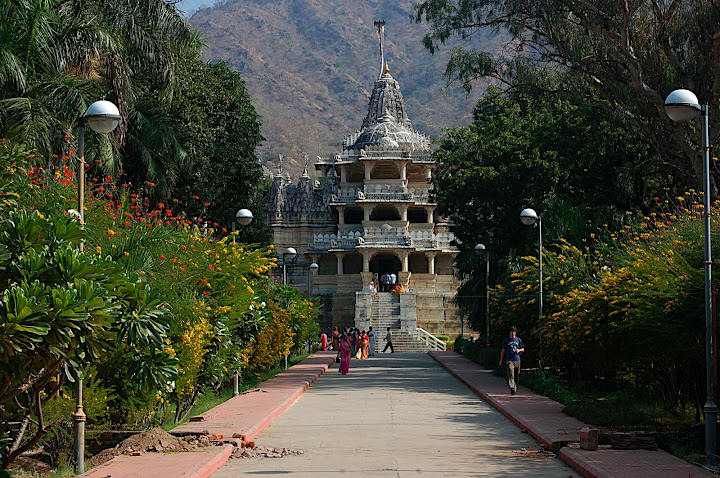
On the drive from Udaipur to Jodhpur, we stopped off in Ranakpur to visit the Adinatha, a Jain temple built in 1439. It's one of the five holy Jain pilgrimige sites in India, but it's sort of in the middle of nowhere, so not quite as overrun with tourists as your typical giant, intricate, centuries-old temple in India. We removed our shoes and walked in through the entrance (pictured above) to be greeted by a very friendly — and clearly devout — Jain man dressed in what looked like a Roman toga.
High Priest: Hello, and welcome to the Adinatha. I am the high priest of the temple. Would you allow me to show you around and explain the history of the temple and some of the important facets of the Jain religion?
M: Sure! Thank you very much! We'd like that very much!

After a few days of being hounded by hotel touts, shopkeepers, and beggars, it was quite a relief to be in a place free from that, where people were just friendly for the sake of being friendly and you could be shown around a temple — not by some huckster trying to scam a few dollars off you — but by a man of god who just wanted to share his faith with strangers.
He showed us around some (not all) of the 1444 engraved pillars, each one individually carved, no two identical. He showed us the tree trunk that looked just like the trunk of the Indian god Ganesh and explained to us that he was the 17th generation of high priests dating back to the early days of the temple.
At the end of the tour, the priest explained to us that they were a poor people and that maintenance of this beautiful cathedral was paid for by the kind generosity of pilgrims and tourists. I gladly gave the man 200 rupees, happy to contribute to the upkeep of such an architectural and religious treasure. On our way out we saw a group of tourists greeted by another Jain togate.

Huckster: Hello. I am the high priest of the temple.
I couldn't believe that some unscrupulous hawker would commit open blasphemy in a holy temple mere feet from the real high priest. And the poor suckers believed him! And no doubt gave him money that should be going to the temple . . .
But I came across many true believers in my brief travels. Most people I spoke with seemed to honestly believe in Hindu or Muslim god(s). But for most of the Hindus it seemed to be a more personal experience than religion in the west. My Gujarati host didn't go to temple, but he believed in the gods. His favorite god was Lord Vishnu because of his message of peace. My favorite Hindu god is Ganesh. People pray to him to remove obstacles, but I like him because of the elephant head. My host was a religious Hindu, but his favorite Christian god was St. Jude, whom people pray to for help with lost causes.

Of course, in the swankier parts of Mumbai, religion seems to lose its grip. Like everywhere else, the young, cosmopolitan hipsters are more educated and wealthy, like Western dress and music, and aren't as bothered by the Bhagavad Gita. But this is still a tiny fraction of the population. In Gujarat and Rajasthan, Hinduism seemed an important part of life. Ganesh was everywhere, people prayed to Vishnu, cows were sacred, people bathed in the Ganges (and you had better have one or more gods on your side if you are going to go come in personal contact with a river that washes away the ashes from funeral pyres, including the occasional whole dead baby floating along).
And yes, I did observe a small bit of tension between Hindus and Muslims only a couple of weeks after the attacks in Mumbai. Our hotel manager in Udaipur was convinced that Mulims in India are really on Pakistan's side. Almost everyone who spoke on the subject of the attacks — a subject I never brought up — expressed visible anger at Pakistan and wanted their government to do something about it instead of just talking. But only in that one case did it manifest itself as a Hindu-Muslim conflict instead of an India-Pakistan conflict.
In general people were very comfortable talking about their religious beliefs and asking me about mine. My psychiatrist friend from the train ride to Bera had spent quite some time explaining how important religion was to his life before turning the tables.
Psychiatrist: And you? Are you Christian?
M: No, I'm Jewish. But actually I'm not much of a believer.
And then I waited to see the reaction. Look, I think people are mostly good, but I've encountered some quirky beliefs about my people in far away lands. Eleven years ago my tour guide in Hanoi spent a day explaining to us how the Chinese had invaded several times and when they visit they throw trash on the ground; how the French had colonized them, treated them like animals, and then on their way out burned as many temples as they could; and finally how the Americans had waged a long and nasty war in their country. The next day on a boat in the middle of Halong Bay, he said he forgave all these people for what they'd done.
But there was one group of people he hated: Jews. You see, one time one of his customers refused to pay an extra five-dollar charge he claimed he wasn't told about. So my tour guide punched him in the face and made him take the bus back to town. The tour guide's friend kindly explained to the guide that it was because the customer was from a country that's all Jews. And there you have it. Buddhists, Catholics, and Protestants (and sure, some Jews, too) can invade, burn, and destroy on a massive scale and they're all forgiven. One Jew (maybe?) stiffs him five bucks and he hates us all forever. So there I was on a boat in the middle of the otherwise deserted bay with my Kung Fu-trained guide, a crew of three and just me and my female companion. If the guy wanted to hit me on the head and thrown me over, no one would ever find me. Of course, my companion then helpfully blurts out "Oh come on, don't you know Mithridates is Jewish?" But everything worked out fine and by the end of the trip I hope some prejudices had been dispelled.
OK, sincere apologies for the Vietnamese diversion. Here we are back in the train waiting to see if my friend harbored any such feelings.
But no, not this guy. He had nothing but fondness and praise for my people.
P: Oh, a Jew! Jews are wealthy industrialists in your country. And you have great power and influence in your government!
M: Uh, well . . .
P: Yes, it's true. I read that somewhere.
And it was clear that this just made him have more respect for me. My brief protests to the contrary, suggesting that this might be a simplistic exaggeration and crude generalization, were taken as merely modesty on my part. From his point of view, I was a member of a wealthy and powerful caste in my country and he was paying me a compliment.


On the drive from Udaipur to Jodhpur, we stopped off in Ranakpur to visit the Adinatha, a Jain temple built in 1439. It's one of the five holy Jain pilgrimige sites in India, but it's sort of in the middle of nowhere, so not quite as overrun with tourists as your typical giant, intricate, centuries-old temple in India. We removed our shoes and walked in through the entrance (pictured above) to be greeted by a very friendly — and clearly devout — Jain man dressed in what looked like a Roman toga.
High Priest: Hello, and welcome to the Adinatha. I am the high priest of the temple. Would you allow me to show you around and explain the history of the temple and some of the important facets of the Jain religion?
M: Sure! Thank you very much! We'd like that very much!

After a few days of being hounded by hotel touts, shopkeepers, and beggars, it was quite a relief to be in a place free from that, where people were just friendly for the sake of being friendly and you could be shown around a temple — not by some huckster trying to scam a few dollars off you — but by a man of god who just wanted to share his faith with strangers.
He showed us around some (not all) of the 1444 engraved pillars, each one individually carved, no two identical. He showed us the tree trunk that looked just like the trunk of the Indian god Ganesh and explained to us that he was the 17th generation of high priests dating back to the early days of the temple.
At the end of the tour, the priest explained to us that they were a poor people and that maintenance of this beautiful cathedral was paid for by the kind generosity of pilgrims and tourists. I gladly gave the man 200 rupees, happy to contribute to the upkeep of such an architectural and religious treasure. On our way out we saw a group of tourists greeted by another Jain togate.

Huckster: Hello. I am the high priest of the temple.
I couldn't believe that some unscrupulous hawker would commit open blasphemy in a holy temple mere feet from the real high priest. And the poor suckers believed him! And no doubt gave him money that should be going to the temple . . .
But I came across many true believers in my brief travels. Most people I spoke with seemed to honestly believe in Hindu or Muslim god(s). But for most of the Hindus it seemed to be a more personal experience than religion in the west. My Gujarati host didn't go to temple, but he believed in the gods. His favorite god was Lord Vishnu because of his message of peace. My favorite Hindu god is Ganesh. People pray to him to remove obstacles, but I like him because of the elephant head. My host was a religious Hindu, but his favorite Christian god was St. Jude, whom people pray to for help with lost causes.

Of course, in the swankier parts of Mumbai, religion seems to lose its grip. Like everywhere else, the young, cosmopolitan hipsters are more educated and wealthy, like Western dress and music, and aren't as bothered by the Bhagavad Gita. But this is still a tiny fraction of the population. In Gujarat and Rajasthan, Hinduism seemed an important part of life. Ganesh was everywhere, people prayed to Vishnu, cows were sacred, people bathed in the Ganges (and you had better have one or more gods on your side if you are going to go come in personal contact with a river that washes away the ashes from funeral pyres, including the occasional whole dead baby floating along).
And yes, I did observe a small bit of tension between Hindus and Muslims only a couple of weeks after the attacks in Mumbai. Our hotel manager in Udaipur was convinced that Mulims in India are really on Pakistan's side. Almost everyone who spoke on the subject of the attacks — a subject I never brought up — expressed visible anger at Pakistan and wanted their government to do something about it instead of just talking. But only in that one case did it manifest itself as a Hindu-Muslim conflict instead of an India-Pakistan conflict.
In general people were very comfortable talking about their religious beliefs and asking me about mine. My psychiatrist friend from the train ride to Bera had spent quite some time explaining how important religion was to his life before turning the tables.
Psychiatrist: And you? Are you Christian?
M: No, I'm Jewish. But actually I'm not much of a believer.
And then I waited to see the reaction. Look, I think people are mostly good, but I've encountered some quirky beliefs about my people in far away lands. Eleven years ago my tour guide in Hanoi spent a day explaining to us how the Chinese had invaded several times and when they visit they throw trash on the ground; how the French had colonized them, treated them like animals, and then on their way out burned as many temples as they could; and finally how the Americans had waged a long and nasty war in their country. The next day on a boat in the middle of Halong Bay, he said he forgave all these people for what they'd done.
But there was one group of people he hated: Jews. You see, one time one of his customers refused to pay an extra five-dollar charge he claimed he wasn't told about. So my tour guide punched him in the face and made him take the bus back to town. The tour guide's friend kindly explained to the guide that it was because the customer was from a country that's all Jews. And there you have it. Buddhists, Catholics, and Protestants (and sure, some Jews, too) can invade, burn, and destroy on a massive scale and they're all forgiven. One Jew (maybe?) stiffs him five bucks and he hates us all forever. So there I was on a boat in the middle of the otherwise deserted bay with my Kung Fu-trained guide, a crew of three and just me and my female companion. If the guy wanted to hit me on the head and thrown me over, no one would ever find me. Of course, my companion then helpfully blurts out "Oh come on, don't you know Mithridates is Jewish?" But everything worked out fine and by the end of the trip I hope some prejudices had been dispelled.
OK, sincere apologies for the Vietnamese diversion. Here we are back in the train waiting to see if my friend harbored any such feelings.
But no, not this guy. He had nothing but fondness and praise for my people.
P: Oh, a Jew! Jews are wealthy industrialists in your country. And you have great power and influence in your government!
M: Uh, well . . .
P: Yes, it's true. I read that somewhere.
And it was clear that this just made him have more respect for me. My brief protests to the contrary, suggesting that this might be a simplistic exaggeration and crude generalization, were taken as merely modesty on my part. From his point of view, I was a member of a wealthy and powerful caste in my country and he was paying me a compliment.

Wednesday, January 14, 2009
India IV: Driver's Education
MITHRIDATES
Our car came to a sudden (by American standards — it was par for the course in India) stop in the middle of the highway about halfway from Delhi to Agra. Traffic had come to a complete standstill and we all got out to see what was happening. Apparently some car had broken down and the northbound drivers tried to swerve around it only to be stared down by southbound vehicles. Now this sort of thing happens all the time in India, but usually the traffic finds a way. But not this time. Traffic in both directions came to a standstill. Well, that was fine by us. We had been in the car for a couple of hours and could use a leg-stretch.
A man was standing on the side of the road with a monkey, so of course I paid my rupees and got to shake the monkey's hand. Then I realized that probably the last thing that monkey had done with that hand was throw feces at the previous tourist who came by. Eventually everything sorted itself out and the car got going again, but it was another three hours before I found a place to wash my hand, and so I spent the rest of the car ride holding my hand out in front of me, making sure it didn't come in contact with anything I might ever touch again.
But that was twelve years ago. Had things changed? Some of the major roads are a in a bit better repair, but it's still the same old hold-on-for-dear-life chaos as autorickshaws, cars, cows, chickens, dogs, pedestrians, beggars, lorries, and scooters all fight through on the same laneless roads. The Law of the Jungle is the only apparent rule of the road, as small things just make sure to get out of the way of bigger things.
The fascinating thing I learned this time around was the class distinction between the different types of drivers-for-hire. Of course, like anywhere else, the car you own has some status attached to it. My Gujarati host was beaming proud that the Ambassador he was driven to work in every day was the same car used by the top government officials. But as far as I could tell there was status attached to the drivers as well. The taxi drivers, for example, had visible contempt for the rickshaw drivers, who were far more interesting. So we'll start with them.
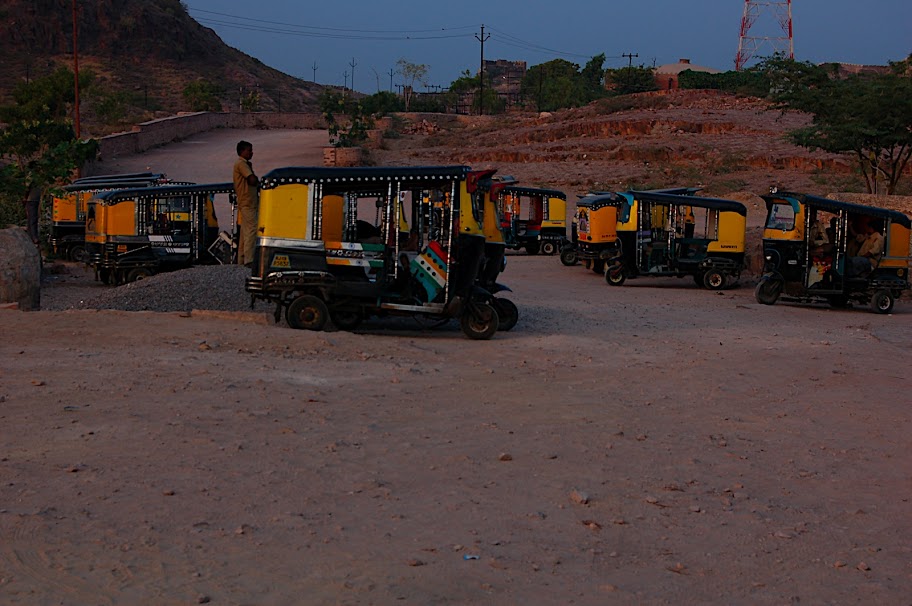
Perhaps it's the openness of the rickshaw itself, but their drivers tended to be chatterboxes. Even the guy in Ahmedabad who didn't speak a word of English was contantly gabbing away. Early in the day I'd point out places on the map for him to take us. Who needs a common language when you can just point to the intersection? Well, apparently map-reading isn't part of the standard public-school curriculum. It soon became clear that he couldn't decipher the map, and so we'd say the name of a place — Gandhi's Ashram, IMM — until he recognized it. He'd then pull over and chat with another driver or random person, who might have one direction for him, and when that direction exhausted itself he consulted someone else. Taking one direction-piece of the itinerary at a time, we'd inch closer to our destination and usually make it there (one particular aborted cafe trip excepted). This disinterest in navigation by map seemed pretty standard. One driver in Mumbai clearly only knew the names of the neighborhoods. You could say "Fort," but good luck trying to specify a building or a street.
But this lack of basic skills one might associate with a driver-for-hire was made up for by the friendliness and casual nature with which they seemed to perform their duties. Our Ahmedabad driver would often stop off at his favorite local pit-stop for Masala Chai (no, not as good as Mom's). He'd bring us a cup and chat with his buddies while locals would come gawk at the white guys and some would practice a bit of English.
Local: Where from?
M: Chicago
L: [Blank stare]
M: US? United States?
L: [Blanker stare]
M: America
L: Ah-May-REEK-uh!
M: Yeah, Ahmayreekuh . . .
But these were some of the best bits of the India trip. None of the sites in Ahmedabad were particularly spectacular. OK, Gandhi's Ashram was very cool and the Indian Institute of Management designed by Louis Kahn was impressive, mostly because it felt like Stanford on the inside, but surrounded by high wall and barbed wire with the poverty of the city creeping right up to the walls. But chilling with the driver on the corner you could sit back, hang out, drink some tea, and watch the locals go about their business. In Udaipur, our rickshaw driver made two stops (to and from the Monsoon Palace — the worst-kept tourist site on the planet) at his local tobacconist to pick up some of Paan — the Betel leaf/nut mixture that Wikipedia describes as a "palate cleanser and breath freshener" — not sure about that, but it certainly turns your teeth red and makes you spit nasty red juice. The detour into his neighborhood was clearly the best part of that excursion. Kids played in the street, donkeys and cows strolled around, locals came by the water pump to wash their feet. Good stuff.
The taxi drivers weren't nearly as much fun. Sure, it was a more comfortable ride, but not much character, not much conversation and a guaranteed stop at the "best restaurant on the way" for mediocre food and a nice kickback to the driver. The driver from Osian to Jodhpur was kind enough to offer me what he called "opium" before he popped some sort of narcotic into his mouth to get him through the rest of the drive. At least he washed it down with some chai to keep him awake. The taxis did seal you off from the beggars and choking pollution, but they also sealed you off from the side streets, local tea-stops, conversation and all the sights and sounds that make it worth going to India in the first place . . .
Our car came to a sudden (by American standards — it was par for the course in India) stop in the middle of the highway about halfway from Delhi to Agra. Traffic had come to a complete standstill and we all got out to see what was happening. Apparently some car had broken down and the northbound drivers tried to swerve around it only to be stared down by southbound vehicles. Now this sort of thing happens all the time in India, but usually the traffic finds a way. But not this time. Traffic in both directions came to a standstill. Well, that was fine by us. We had been in the car for a couple of hours and could use a leg-stretch.
A man was standing on the side of the road with a monkey, so of course I paid my rupees and got to shake the monkey's hand. Then I realized that probably the last thing that monkey had done with that hand was throw feces at the previous tourist who came by. Eventually everything sorted itself out and the car got going again, but it was another three hours before I found a place to wash my hand, and so I spent the rest of the car ride holding my hand out in front of me, making sure it didn't come in contact with anything I might ever touch again.
But that was twelve years ago. Had things changed? Some of the major roads are a in a bit better repair, but it's still the same old hold-on-for-dear-life chaos as autorickshaws, cars, cows, chickens, dogs, pedestrians, beggars, lorries, and scooters all fight through on the same laneless roads. The Law of the Jungle is the only apparent rule of the road, as small things just make sure to get out of the way of bigger things.
The fascinating thing I learned this time around was the class distinction between the different types of drivers-for-hire. Of course, like anywhere else, the car you own has some status attached to it. My Gujarati host was beaming proud that the Ambassador he was driven to work in every day was the same car used by the top government officials. But as far as I could tell there was status attached to the drivers as well. The taxi drivers, for example, had visible contempt for the rickshaw drivers, who were far more interesting. So we'll start with them.
Perhaps it's the openness of the rickshaw itself, but their drivers tended to be chatterboxes. Even the guy in Ahmedabad who didn't speak a word of English was contantly gabbing away. Early in the day I'd point out places on the map for him to take us. Who needs a common language when you can just point to the intersection? Well, apparently map-reading isn't part of the standard public-school curriculum. It soon became clear that he couldn't decipher the map, and so we'd say the name of a place — Gandhi's Ashram, IMM — until he recognized it. He'd then pull over and chat with another driver or random person, who might have one direction for him, and when that direction exhausted itself he consulted someone else. Taking one direction-piece of the itinerary at a time, we'd inch closer to our destination and usually make it there (one particular aborted cafe trip excepted). This disinterest in navigation by map seemed pretty standard. One driver in Mumbai clearly only knew the names of the neighborhoods. You could say "Fort," but good luck trying to specify a building or a street.
But this lack of basic skills one might associate with a driver-for-hire was made up for by the friendliness and casual nature with which they seemed to perform their duties. Our Ahmedabad driver would often stop off at his favorite local pit-stop for Masala Chai (no, not as good as Mom's). He'd bring us a cup and chat with his buddies while locals would come gawk at the white guys and some would practice a bit of English.
Local: Where from?
M: Chicago
L: [Blank stare]
M: US? United States?
L: [Blanker stare]
M: America
L: Ah-May-REEK-uh!
M: Yeah, Ahmayreekuh . . .
But these were some of the best bits of the India trip. None of the sites in Ahmedabad were particularly spectacular. OK, Gandhi's Ashram was very cool and the Indian Institute of Management designed by Louis Kahn was impressive, mostly because it felt like Stanford on the inside, but surrounded by high wall and barbed wire with the poverty of the city creeping right up to the walls. But chilling with the driver on the corner you could sit back, hang out, drink some tea, and watch the locals go about their business. In Udaipur, our rickshaw driver made two stops (to and from the Monsoon Palace — the worst-kept tourist site on the planet) at his local tobacconist to pick up some of Paan — the Betel leaf/nut mixture that Wikipedia describes as a "palate cleanser and breath freshener" — not sure about that, but it certainly turns your teeth red and makes you spit nasty red juice. The detour into his neighborhood was clearly the best part of that excursion. Kids played in the street, donkeys and cows strolled around, locals came by the water pump to wash their feet. Good stuff.
The taxi drivers weren't nearly as much fun. Sure, it was a more comfortable ride, but not much character, not much conversation and a guaranteed stop at the "best restaurant on the way" for mediocre food and a nice kickback to the driver. The driver from Osian to Jodhpur was kind enough to offer me what he called "opium" before he popped some sort of narcotic into his mouth to get him through the rest of the drive. At least he washed it down with some chai to keep him awake. The taxis did seal you off from the beggars and choking pollution, but they also sealed you off from the side streets, local tea-stops, conversation and all the sights and sounds that make it worth going to India in the first place . . .
Sunday, January 11, 2009
India III: Land of the Free
MITHRIDATES
I'm sitting in the living room of my Gujarati host, thoroughly enjoying the kind hospitality he's offered to a complete stranger.
Host: Would you like some more Chai?
M: Oh, no thanks. It was great, but I've had plenty. Thank you.
H: But really, it's no problem at all . . .
And it wasn't. One quick nod in the direction of his wife and a couple of words in Gujarati (or was it Hindi?) was all it took. My host's mom went back in the kitchen and brewed up another pot of — truly delicious, no exaggeration here — Masala Chai. (I'm not much of a caffeinator, but I think I'm addicted to Mom's Masala Chai. Have to figure out how to get the right ingredients and make the stuff back home).
It seems like a great, traditional family life. Host works seven days a week while Wife and Mom stay at home every day and cook every meal, scrub every pot, and clean every room. I got to experience that home life for just a couple of days and it was delightful. Wife and Mom got up early every morning and made us Chai and breakfast; then they went shopping for fresh ingredients for the delicious dinner they cooked at night. Mom would be personally offended if you only had three servings, and so I ate until near-bursting. Host, as you might imagine, appeared to be struggling a bit with the "diet" he claimed to be on. I'd come home from sightseeing and watch some cricket with Host's dad, who seemed to live a life of complete leisure at this point and liked practicing English with his guest.
Host was married (by arrangement, of course) at 21; he's had the same career for ~25 years. As far as I can tell both parties seem happy with the, er, "arrangement" and I make no judgment on the process. Hell, it might have saved me a lot of trouble over the past 15 years if my parents had given me a bride at 21 instead of a sweater and a fancy dinner. And this was definitely par for the course in these parts. I talked to as many locals as I could on train rides and such, and by my accounts every one of them had their marriage arranged. And, like Host, they had all been working seven days a week in the same profession their whole adult lives. I had one memorable discussion with a pyschiatrist and a civil engineer in a sleeper class (no AC) cabin on a train from Bera to Abu Road.
Psychiatrist: So you're traveling on your own? Isn't it lonely?
M: Yeah, traveling alone. And it's not lonely. You meet people on the trains and in hostels. It's lots of fun. You meet more people this way.
P: In India we always travel with our families. Today I'm just coming back from a public hospital where I work once a week for extra money. We don't have time to travel alone. In India, if you leave your job to go travel it won't be there for you when you get back. We dream of traveling to other countries, but we can't afford it.
Engineer: In India we don't have personal freedom like in America. We have our job and we work every day. We don't travel around by ourselves. We live for our children and for our parents. We don't have choices in whom we marry, but we like it this way. Americans live for themselves, not their families.
Perhaps slightly exaggerating the state of affairs in America . . .
P: I had an arranged marriage at 22. Are you married?
M: No I'm still single.
P: How old are you?
M: 36.
I wish I had photographed the look of shock on my companions' faces.
E: Why aren't you married?!
P: He doesn't need to marry. He gets all the benefits of marriage without the costs. [laughter]
Well, not all the benefits. I have to figure out how to make my own Masala Chai.
P: How many girlfriends have you had? [girlish giggle]
M: Uh . . . more than one . . .
P: Ha. Political answer. In India, we like our lives, but we dream of promiscuity — of having lots of girlfriends.
Yeah, me too. I haven't had a date* worth the time in months . . .
P: Will you get married?
M: Yeah, sure, when I find the right girl.
P: Ha. In India everyone gets married at 21, 22. People don't even think if they can afford to raise a family. But everyone has to get married.
E: Are you worried about getting a job when you graduate?
M: No. The market's not great right now, but there are still more jobs than graduates in my field.
E: But unemployment is huge in America! Much worse than in India, I think.
A quick look out the window seemed to tell a different story about employment in the Indian countryside . . .
This was the Indian middle class. (OK, sure, just a tiny slice of it upon which I'm basing my whole assessment). Apparently genuinely happy with their lives, but working all the time just to get their families by. No girlfriends, but an arranged marriage at an early (by my reckoning) age. Happy with India, but a desperate longing on their faces when talking about traveling to other countries. Happy with their marriages, but clearly wondering what it would be like to have had a girlfriend or two at some point in their lives. Content with the direction their lives went, but by their own admission they never really had much say in choosing that path.
India was a free country as far as the government was concerned. No one was restricting their movement or speech. And clearly the government wasn't restricting how many children they had (attempts at forced sterilization in the 1970s aside). But family life and culture (and let's face it, relative lack of wealth) had certainly put a clamp down on individual freedom.
Hey, maybe choice is overrated. Who cares if you get to pick your path as long as the path turns out OK?
(I do . . .)
*For the record that was not a date. And it certainly didn't lead to any promiscuity. But yes, it was worth the time. Wait, is everyone else reading this? Sorry about that . . .
I'm sitting in the living room of my Gujarati host, thoroughly enjoying the kind hospitality he's offered to a complete stranger.
Host: Would you like some more Chai?
M: Oh, no thanks. It was great, but I've had plenty. Thank you.
H: But really, it's no problem at all . . .
And it wasn't. One quick nod in the direction of his wife and a couple of words in Gujarati (or was it Hindi?) was all it took. My host's mom went back in the kitchen and brewed up another pot of — truly delicious, no exaggeration here — Masala Chai. (I'm not much of a caffeinator, but I think I'm addicted to Mom's Masala Chai. Have to figure out how to get the right ingredients and make the stuff back home).
It seems like a great, traditional family life. Host works seven days a week while Wife and Mom stay at home every day and cook every meal, scrub every pot, and clean every room. I got to experience that home life for just a couple of days and it was delightful. Wife and Mom got up early every morning and made us Chai and breakfast; then they went shopping for fresh ingredients for the delicious dinner they cooked at night. Mom would be personally offended if you only had three servings, and so I ate until near-bursting. Host, as you might imagine, appeared to be struggling a bit with the "diet" he claimed to be on. I'd come home from sightseeing and watch some cricket with Host's dad, who seemed to live a life of complete leisure at this point and liked practicing English with his guest.
Host was married (by arrangement, of course) at 21; he's had the same career for ~25 years. As far as I can tell both parties seem happy with the, er, "arrangement" and I make no judgment on the process. Hell, it might have saved me a lot of trouble over the past 15 years if my parents had given me a bride at 21 instead of a sweater and a fancy dinner. And this was definitely par for the course in these parts. I talked to as many locals as I could on train rides and such, and by my accounts every one of them had their marriage arranged. And, like Host, they had all been working seven days a week in the same profession their whole adult lives. I had one memorable discussion with a pyschiatrist and a civil engineer in a sleeper class (no AC) cabin on a train from Bera to Abu Road.
Psychiatrist: So you're traveling on your own? Isn't it lonely?
M: Yeah, traveling alone. And it's not lonely. You meet people on the trains and in hostels. It's lots of fun. You meet more people this way.
P: In India we always travel with our families. Today I'm just coming back from a public hospital where I work once a week for extra money. We don't have time to travel alone. In India, if you leave your job to go travel it won't be there for you when you get back. We dream of traveling to other countries, but we can't afford it.
Engineer: In India we don't have personal freedom like in America. We have our job and we work every day. We don't travel around by ourselves. We live for our children and for our parents. We don't have choices in whom we marry, but we like it this way. Americans live for themselves, not their families.
Perhaps slightly exaggerating the state of affairs in America . . .
P: I had an arranged marriage at 22. Are you married?
M: No I'm still single.
P: How old are you?
M: 36.
I wish I had photographed the look of shock on my companions' faces.
E: Why aren't you married?!
P: He doesn't need to marry. He gets all the benefits of marriage without the costs. [laughter]
Well, not all the benefits. I have to figure out how to make my own Masala Chai.
P: How many girlfriends have you had? [girlish giggle]
M: Uh . . . more than one . . .
P: Ha. Political answer. In India, we like our lives, but we dream of promiscuity — of having lots of girlfriends.
Yeah, me too. I haven't had a date* worth the time in months . . .
P: Will you get married?
M: Yeah, sure, when I find the right girl.
P: Ha. In India everyone gets married at 21, 22. People don't even think if they can afford to raise a family. But everyone has to get married.
E: Are you worried about getting a job when you graduate?
M: No. The market's not great right now, but there are still more jobs than graduates in my field.
E: But unemployment is huge in America! Much worse than in India, I think.
A quick look out the window seemed to tell a different story about employment in the Indian countryside . . .
This was the Indian middle class. (OK, sure, just a tiny slice of it upon which I'm basing my whole assessment). Apparently genuinely happy with their lives, but working all the time just to get their families by. No girlfriends, but an arranged marriage at an early (by my reckoning) age. Happy with India, but a desperate longing on their faces when talking about traveling to other countries. Happy with their marriages, but clearly wondering what it would be like to have had a girlfriend or two at some point in their lives. Content with the direction their lives went, but by their own admission they never really had much say in choosing that path.
India was a free country as far as the government was concerned. No one was restricting their movement or speech. And clearly the government wasn't restricting how many children they had (attempts at forced sterilization in the 1970s aside). But family life and culture (and let's face it, relative lack of wealth) had certainly put a clamp down on individual freedom.
Hey, maybe choice is overrated. Who cares if you get to pick your path as long as the path turns out OK?
(I do . . .)
*For the record that was not a date. And it certainly didn't lead to any promiscuity. But yes, it was worth the time. Wait, is everyone else reading this? Sorry about that . . .
PHUTATORIUS
First off, it cracks me up that you ended a post about marriage and freedom with "I do." Second: I dunno — sometimes I think I'd feel a lot freer if my parents lived in our house. They could look after the kids now and then, and I'd get out a lot more.
But you make some good points about freedom. There are all sorts of pressures and compulsions out there that make us less free — and they don't all come from government. I think some of the New Deal theorists made this point back in the day. We're fortunate in America that we (most of us, anyway) are in a position to care about freedom from government — for a lot of people, that's an abstraction and a luxury you don't have time for if you're living in grinding poverty. The state doesn't own you; your boss does.
Economic and social pressures don't carry the same weight as the whim of a sovereign state backed by a monopoly of force: in theory you can always tell your boss or your husband to take a hike. But as a practical matter, sometimes the consequences of asserting these freedoms are as severe and painful as facing the state and its guns. Try telling the Afghan woman the law says she can step out of her burqa into a pair of jeans.
It's a shame that so often we (broadly, meaning everyone) fight hard and win battles that confer a slice of freedom, only to find that there's some other Trope of Authority — God, family, the Man, Dr. Phil, the Invisible Hand — telling us what to do or say. To me it all reduces to two truths — you can call 'em laws if you want:
(1) No one can ever be completely free.
(2) The fact that we all have to live together on a big round rock with a scarcity of resources means there's an outer limit to the total amount of freedom we have to parse out.
Thursday, January 08, 2009
India II: Animal Kingdom
 MITHRIDATES
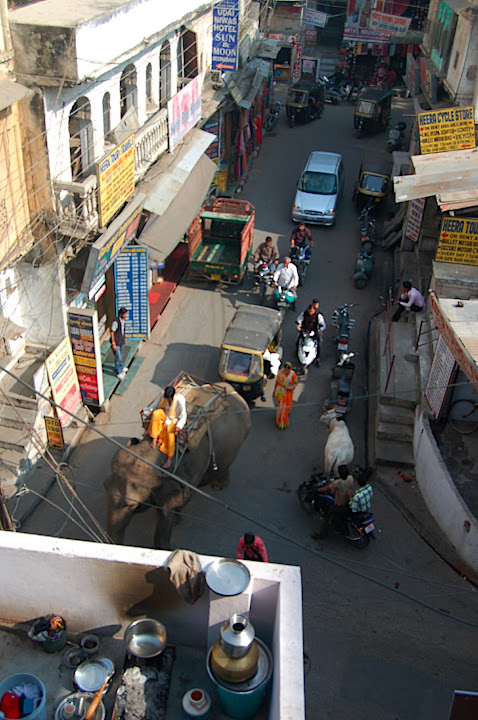
India may have a democracy for its people, but the animals don't appear to recognize it. They are the undisputed kings of this country. That's an elephant walking down the street in Udaipur. Happens all the time. Taxi, rickshaw, scooter? Sorry, you'll just have to wait for Babar to make his way up the hill — and he ain't in no hurry. Even the cow gets out of the way. You think cows are messy? What happens when our big gray friend feels the need to relieve himself? There's no alternate week street cleaning service — it just becomes part of the permanent living landscape. Man can pave the roads, but the cows, dogs and elephants spend the next several decades reclaiming it for themselves.
And what of those sacred cows? In most states in India it is illegal to kill a cow. As a result, not only does one have to settle for a bowel-disturbing Chicken Maharaja King at the McDonald's at Mumbai Central, but once a cow stops giving milk its owner releases it into the wild. "Wild" in India meaning everything from backcountry to the side of the highway to the middle of town. I stayed for a couple of days with a family in Gandhinagar, Gujarat, and one such noble creature had made his retirement home in a small field in a packed residential area. No cricket to be played there. And wherever we went cows ate from the dumpster, crowded the streets, and created fertilizer. If cows are sacred and god is in the cow, then is that godshit I just stepped in?
But they're not alone. Wild (again, rabid?) dogs abound. The good news is that Indian dogs — unlike their Ecuadorian counterparts — seem pretty chill. You might have to step over several each block, but they're so used to the multitude and have nothing to guard that they leave passers by alone. Petting one might lead to a few trips to the clinic, but other than that they seemed harmless. One lucky mongrel got to ride in the lap of his scooter-riding master down the highway. Quite a remarkable training feat if you ask me — or maybe its just instinct to curl up in a ball and stay put.
I grew quite fond of the neighborhood monkeys. Two of them made the rounds every morning and one liked to stop right in the open doorway. Never came in the living room though, just took a peek in, watched a bit of the cricket, and went on his merry way.
But the leopards were the highlight. In southern Rajasthan, in the Mt Abu-Udaipur-Jodhpur triangle is a giant wildlife refuge filled with Panthera Pardi. I'm not sure what "refuge" means in India — other than the government owns the land — but it did look like development was pretty limited. I went on a leopard "safari" out of Bera and in the late afternoon hopped in a jeep with the owner, Sunil, his son, and an employee, Debashish, to go looking for leopards as they came down from the hills to hunt. On the way to the refuge we picked up a goat — what's the goat for? — and Debashish tied the poor bugger to a stake at the bottom of the hill and got out of the jeep to wait in the bushes. We drove around for a while until we got a call from Sunil's brother that the leopard had made a "kill". Apparently, Sunil's brother hadn't left anyone with his goat and while he walked to his jeep our spotted friend took advantage and claimed her dinner. We spent the next several hours watching the feast — after rescuing our own had gadya — and catching glimpses of the two cubs safe up in the hills occasionally taking peeks to make sure some scraps were left for them. We were standing outside the jeep, probably fifteen feet from the big cat, who knew we were there, but didn't seem to care.
 She ate everything but the hind hooves that were still attached to the post. Too bad about the goat and all, but the girl's gotta eat something. As it turns out, that something is often a goat stolen from the local village. This isn't Africa, where wide open spaces and plentiful wildlife allow the big cats to feast on wild gazelles. There's always a village nearby and the leopards survive in part by sneaking into a local's house and taking his livestock. The villagers don't like this, naturally, and sometimes resort to poisoning the carcass. When the leopard comes back to finish off his dinner, she eats the poison. In a case of local businesses looking out for their future where the central government is ill-equipped to regulate, Sunil decided to pay the local villagers for their losses in return for not poisoning the leopards. A small cost to the businessman, but a huge gain perhaps for the local leopard population.
Such a long post and I haven't got to boars, camels, crocodiles, donkeys, or the giant lizard who shared a cabin with me. Oh well, maybe in a future post.
Friday, January 02, 2009
India I: Same Basic Idea
MITHRIDATES
It's ten days after the Mumbai attacks and I'm sitting in my 2-tier AC berth, waiting for my first Indian train trip ever. It's a miracle I made it this far, what with the increased security these days at Mumbai Central.
Heading in to the station I was greeted with a "Security is Never Everyone's Problem" sign. Not sure what they were going for. But you could see they meant business. There was a column separating the main entrance: to the left were three metal detectors; to the right a big "Do Not Enter" sign. I walked through a metal detector that gave a loud beep as I passed through. But I was obviously no threat. The dozen or so security personnel camped out just inside the station didn't interrupt their discussions and milling about for one second. I stopped for a second just to make sure and looked back to see several people casually walking around the metal detectors through the out door. There would be no attacks today, my friends.
But here we are back on the train. For those of you unfamiliar, 2-tier AC is the second highest class of the nine different classes on Indian trains. Four berths on the right side enclosed by a curtain.
Travel Companion 1: Where are you from?
M: America
TC1: Oh, just like India!
His emphasis suggested he didn't doubt the veracity of his statement one bit. I, on the other hand, needed a bit of convincing. I had landed in the middle of last night at the decaying international airport and was immediately overwhelmed by the stench of dung that permeated the cabin even before the doors were opened. I'd been to Mumbai before, but I'd forgotten the smell. The overpowering, unavoidable smell of India. It took us over an hour by cab to cover the six miles to my hotel, located on a side street covered in dust, dirt, and people, animals, and dung of all stripe. Walking around the train station that morning I was confronted by numerous hotel touts and beggars, stepped over sleeping (rabid?) dogs, avoided cows, and learned to navigate through traffic that didn't know any rule of law. I ate a delicious lunch of Butter Chicken for a dollar at a local eatery, while an employee dusted the place on his hands and knees under the tables. I hadn't been there very long, but so far NOTHING about this place resembled my native land.
But I was intrigued.
M: Uh, yeah, kind of like India. But how do you mean?
TC1: Democracy. Same basic idea. You can say what you want!
And there we had it. And I have to admit, I was kind of touched. India might be poorer, denser, older, smellier, but it was a democracy, with basic political freedom. And, legally, for the most part, you really could say what you want. And go where you want. And do what you want. My traveling companion, unlike his Chinese counterpart, for example, was free — and he cherished his freedom.
So India was, after all, just like America, right? There's something to be said for political freedom. And they had it. The train started rolling and I looked out at the India countryside and felt a certain kinship with my Indian companion.
The next day in Ahmedabad, Gujarat I was confronted on the sidewalk by a shirtless beggar carrying what looked like a diseased and near lifeless naked baby. He chased me down the sidewalk thrusting the baby in my direction while the pedestrians on the crowded sidewalk looked on as if nothing out of the ordinary was happening. Several sources — don't know if they're reliable — say these beggars are run by gangs who disfigure the babies intentionally to get more sympathy and then collect anything the beggars gather. Whether that's true or not, they were on most street corners and more wretched and desperate than anything you can find in the US. And there are thousands, millions, tens (hundreds?) of millions equally impoverished.
So maybe there is more to defining a country than political freedom.
I'm not the first person to write about India, but the next several posts are going to cover what I saw, as honestly as I can. The point isn't to point out how awful or wonderful the country is, or ours is by comparison. But it won't be a gushing "your country is so wonderful!" travel blog. I'm not trying to convince you to go or to stay away. Apologies if anyone gets offended by my candid observations about their country. I know this is just one man's observations seen through his uniquely biased eye. But they'll be honest observations and you'll get the good with the bad.
We've got several juicy topics to cover: Indian man on the street thoughts on war with Pakistan, Leopards raiding villages, cow shit, crushing poverty, delicious food, how individual freedom gets crushed but not by the government, living streets, impenetrable forts, and more!
PHUTATORIUS
Glad to have you back, Mithridates. Did your namesake ever make it into India, or was he always stabbing westward?
Just a couple thoughts:
First, on panhandlers. You have to feel that, like most competitive occupations, the best are the most assertive — and the assertive are often the least scrupulous. The thing is, when you're just giving someone money (as opposed to purchasing something) you want it to go to someone who deserves it. They can "deserve" it by serving up some kind of shtick, like the guys at Fenway who play drums on overturned buckets, or the guy in Uptown Manhattan back in the day who would tell Michael Jackson-as-pedophile jokes. Or they can "deserve" it by needing it the most. You have to figure the weakest, the hungriest, the most needy aren't throwing the best elbows to get into your view. Anyway, it sounds like a long way from Harvard Square, where it's the teenager who got into a fight with her parents about the lip ring, so she ran away on some silly romantic trip with her boyfriend and his acoustic guitar. It all makes me want to scream, starting with PUNK ROCKERS DON'T PLAY ACOUSTIC GUITARS! But anyway.
Second, if you had to choose: would you prefer prosperity without freedom, or freedom without prosperity?
MITHRIDATES
First, I'm clearly not getting the point across. These people are nothing like any beggars I've seen anywhere in the US. It's just a different ball game. They are hands down the most wretched people I have ever seen (OK, fair enough, I've never been to Congo training camp for child soldiers). And if you're in an open auto-rickshaw they'll corner you at an intersection and paw you. If you give them something a crowd will come after you. You can't help but pity them, but who knows what disease you might get by touching them. It's a horrifically awful situation. Worse for them than you, for sure . . .
Second, you're implying this is the choice and that these people are "free" and just lack prosperity. They might be free in the Hayek, Constitution of Liberty sense, as in the government isn't depriving them of anything. But any other meaning of the word doesn't apply. They have nowhere to go, no opportunity, no one who cares about them, and by some accounts they are enslaved by gangs who control the beggars. That's no freedom and no prosperity.
But we're going to tackle individual freedom in India in a later post.
Sunday, November 30, 2008
The White Tiger
MITHRIDATES
So let's talk about India. Why? Because I'm going there in ten days and am reading a Man Booker Prize for Fiction winning novel by an Indian about India. OK, I know there was a terrible incident in Mumbai this past week, and it was truly awful, but I think it's been covered fairly thoroughly in the Mainstream Media and, quite frankly, I don't really have much to add. Well, except that I'm going to India anyway, you terrorist fuckwads!
 Which brings me to The White Tiger by Aravind Adiga. Look, this obviously isn't the first time you've heard of this truly original novel. Not only do I think how the Economist wants me to think, but I read what the Economist wants me to read. But in case you haven't got around to it yet, please feel free to do so. The book is about social classes, freedom, tradition, and all sorts of other stuff, but the parts about Indian democracy are just brilliant — all through the eyes of an uneducated, impoverished villager. A few highlights to pique your interest:
So let's talk about India. Why? Because I'm going there in ten days and am reading a Man Booker Prize for Fiction winning novel by an Indian about India. OK, I know there was a terrible incident in Mumbai this past week, and it was truly awful, but I think it's been covered fairly thoroughly in the Mainstream Media and, quite frankly, I don't really have much to add. Well, except that I'm going to India anyway, you terrorist fuckwads!
 Which brings me to The White Tiger by Aravind Adiga. Look, this obviously isn't the first time you've heard of this truly original novel. Not only do I think how the Economist wants me to think, but I read what the Economist wants me to read. But in case you haven't got around to it yet, please feel free to do so. The book is about social classes, freedom, tradition, and all sorts of other stuff, but the parts about Indian democracy are just brilliant — all through the eyes of an uneducated, impoverished villager. A few highlights to pique your interest:
- I was listening to a program on the radio about this man called Castro who threw the rich out of his country and freed his people.
- I gather you yellow-skinned men, despite your triumphs in sewage, drinking water, and Olympic gold medals, still don't have democracy. Some politician on the radio was saying that that's why we Indians were going to beat you: we may not have sewage, drinking water, and Olympic gold medals, but we do have democracy. If I were making a country, I'd get the sewage pipes first, then the democracy, then I'd go about giving pamphlets and statues of Gandhi to other people, but what do I know? I'm just a murderer!
- The Great Socialist himself is said to have embezzled one billion rupees from the Darkness, and transferred that money into a bank account in a small, beautiful country in Europe full of white people and black money.
- "It's the way it always is," my father told me that night. "I've seen twelve elections — five general, five state, and two local — and someone else has voted for me twelve times. I've heard that people in the other India get to vote for themselves — isn't that something?"
- They sat in silence, which confused me. If I had just gone into the President's House, I'd roll down the windows and shout it aloud to everyone on the road! "Look at that." "What?" "That Statue." I looked out the window to see a large bronze statue of a group of men — this is a well-known statue, which you will no doubt see in Delhi: at the head is Mahatma Gandhi, with his walking stick, and behind him follow the people of India, being led from darkness to light. The Mongoose squinted at the statue. "What about it? I've seen it before." "We're driving past Gandhi, after just having given a bribe to a minister. It's a fucking joke, isn't it?" "You sound like your wife now," the Mongoose said. "I don't like swearing — it's not part of our traditions here." But Mr. Ashok was too red in the face to keep quiet. "It is a fucking joke — our political system — and I'll keep saying it as long as I like." "Things are complicated in India, Ashok. It's not like in America. Please reserve your judgment."
- The jails of Delhi are full of drivers who are there behind bars because they are taking the blame for their good, solid middle-class masters. We have left the villages, but the masters still own us, body, soul, and arse. Yes, that's right: we all live in the world's greatest democracy. What a fucking joke. Doesn't the driver's family protest? Far from it. They would actually go bragging. Their boy Balram had taken the fall, gone to Tihar Jail for his employer. He was loyal as a dog. He was the perfect servant.
- The Great Indian Rooster Coop. Do you have something like it in China too? I doubt it, Mr. Jiabao. Or you wouldn't need the Communist Party to shoot people and a secret police to raid their houses at night and put them in jail like I've heard you have over there. Here in India we have no dictatorship. No secret police. That's because we have the coop. Never before in human history have so few owed so much to so many, Mr. Jiabao. A handful of men in this country have trained the remaining 99.9 percent — as strong, talented, as intelligent in every way — to exist in perpetual servitude; a servitude so strong that you can put the key of his emancipation in a man's hands and he will throw it back at you with a curse.
Subscribe to:
Posts (Atom)